
Cacti are an emblematic element of the natural landscape of Sinaloa, not only because of their presence in arid ecosystems, but also because of their cultural and historical relevance. The name of the state, derived from the Cahita language, is interpreted as “round pitaya” or “place of pitayas”, in reference to the fruit of a columnar cactus of the genus Stenocereus, characteristic of the dry regions of northern Mexico. This fruit, known as pitaya, is often confused with the pitahaya or “dragon fruit”, belonging to the genus Hylocereus, which is distinguished by being a climbing plant with smooth scaled fruits and pulp with a subtle flavor. In contrast, the Sinaloa pitaya has thorny fruits with juicy and sweet pulp, adapted to conditions of high aridity. This botanical distinction not only highlights the diversity of cacti in Mexico, but also underscores the ecological and symbolic importance of cacti in the regional context.
So why this interest in cacti? The Mexinol project area is divided into two plots, north and south, physically separated by the Nogales-Topolobampo international railway. The southern property, for predominantly agricultural use, preserves in its portion of this portion relicts of halophytic vegetation on bare soil, which will be delimited and protected as part of the environmental conservation measures. In this area, it is not contemplated to carry out palm removal activities; instead, it will be used as a deposit site for the fertile soil removed from the northern property, ensuring that it will not affect the vegetation cover, but an active conservation of the existing natural vegetation. During the baseline studies of the project, a community of sarcocaule scrub was identified in the southern property, a type of vegetation characteristic of extremely arid environments, composed of thorny plants with thick and succulent trunks and branches, capable of storing water to survive in drought conditions. Among these species, cacti stand out, which are the most representative and recognizable element of this ecosystem.
Based on the results obtained in the sampling sites and tours carried out in the Regional Environmental System, a total of 78 species were recorded distributed in 33 families, among which 7 species of cactus were found: Cylindropuntia fulgida, Stenocereus alamosensis, Mammillaria mazatlanensis, Stenocereus thurberi, Pachycereus pecten-aboriginum, Opuntia decumbens and Ferocactus herrerae.
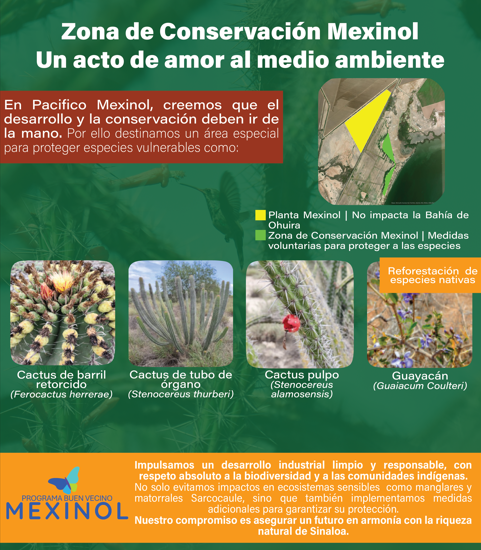
Next, we will talk about the most characteristic cacti of the southern property of Mexinol.
The easiest cactus to recognize is the organ pipe cactus (Stenocereus thurberi), which can reach a height of 5 meters, protruding above the thorny understory. This species can take 150 years toreach maturity and when it blooms (during the night), its flowers are pollinated by bats.
In addition to the ecological importance of the sweet pitaya (Stenocereus thurberi), the economic and cultural value that this species represents for the inhabitants of northern Sinaloa is invaluable.
- Economic importance.
Food: The fruits are a non-timber forest resource with a great demand to be consumed fresh or processed into jams, ice cream, fresh water and even liquors, generating significant income for the inhabitants in each cactus fruiting season.
Forage and Materials: The inhabitants of the region usually use the fruits, flowers and stems as fodder for domestic animals, and the wood of the dried plant is used for artisanal constructions (usually used in roofs, walls, tables and beds) and as fuel (mainly for baking bread), offering another source of income.
- Cultural significance
Cosmovision: The pitaya frequently appears in the songs of the Deer and Pascola dances of the Yoreme Mayo native people who inhabit the region.
Traditional medicine: The sap of the pitaya is used to accelerate wound healing, even being made into tea to treat gastric ulcers.


In the same genus (Stenocerus), we find the octopus cactus (Stenocereus alamosensis). This spiny cactus appears to have outstretched spiny legs, hence its name. But when it blooms, it produces red flowers that bloom during the day, pollinated by hummingbirds. This species is endemic to Sinaloa and Sonora.
Although this cactus is present in the southern area of the Mexinol site and is common throughout the region, it is not attributed significant relevance from an economic or cultural point of view by the local population. Although its fruits have a very sweet taste, no systematic collection or commercial use by the inhabitants has been identified.


The twisted barrel cactus (Ferocactus herrerae) was alsorecorded here. This species is classified as vulnerable by the International Union for Conservation of Nature (IUCN), due to agricultural expansion, causing the loss of sarcocaule scrub. This cactus can reach up to 2 m in height, with a width of up to 40 cm. It’s the twisted nature of the barrel that makes it noticeable, often with yellow flowers blooming on top. The flowers of this cactus are pollinated by bees.
Currently we can find specimens of this cactus as an ornamental plant in commercial areas and main avenues of the region. Although Ferocactus herrerae is not found in NOM 059 SEMARNAT 2010, it is essential to better manage this species to promote conservation, since it is very slow growing and its reproduction occurs only by seeds with a very low percentage of germination survival and is endemic to Mexico and the southern United States.


When we talk about Sinaloa, in addition to remembering the pitaya, we cannot forget the cholla (Cylindropuntia fulgida) shrubby cactus or small tree up to 4 meters high, also known as the jumping cholla, characterized by its cylindrical, green and articulated stems that are easily detached. It has long, dense, yellowish-colored spines covered with sheaths, which hide the stem and stick to clothing or skin. It produces pink-magenta or white-pink flowers, and fleshy, chain-shaped fruits that act as a form of propagation.
The cholla is popular among Sinaloenses because of the ease with which the thorns and stems adhere to the clothing or skin of people and animals and the great difficulty it is to remove them. Often a small part of the spines remains embedded in the skin and usually causes major infections.
But not everything is bad in Cylindropuntia fulgida, the bees are patient and wait until the end of the day to pollinate the flowers and the fruits are so sweet that they are the favorites of many animals, also people usually eat them and it is well worth a wound of their thorns to enjoy them, although the collection of these is not an economic or significant activity.


These are just four of the species of cacti that live in the Sinaloa sarcocaule scrub. Each species is part of a larger food web, which provides shelter for some species and food for others. It is for this reason that the Mexinol project has made the decision to protect and manage this area of sarcocaule scrub. The area will be protected from losses due to agricultural expansion. Annual studies of plant and fauna diversity will be carried out to inform the future management strategy of this area.
Initial management of the area will include expanding the area by planting bare areas, using the same species already found in the area, species of native presence. The restoration plan will include the Guayacán or Holy Tree (Guaiacum coulteri), a species classified as vulnerable on the IUCN Red List. Although not a cactus, this tree is suitable for growing in very arid environments and produces an abundance of beautiful blue flowers, which once pollinated produce a fruit consumed by mammals and birds. Due to its hardwood and medicinal uses, it is very difficult to find in the wild these days. By including this species in the management of the sarcocaule scrub, the Mexinol Project aims to increase the local population of this species.


The biological and cultural richness of the Sinaloa sarcocaule scrub, represented by its emblematic cacti such as the sweet pitaya, the octopus cactus, the twisted barrel and the bouncing cholla, reveals a deep connection between nature and local communities. Not only do these species play an essential role in arid ecosystems, but they have also been a source of food, medicine, tradition, and economic sustenance for generations. In the face of the threats faced by this vegetation, such as agricultural expansion and habitat loss, the Mexinol Project proposes a comprehensive conservation strategy that recognizes the ecological, economic, and cultural value of these species. By protecting and restoring the sarcocaule shrubland, not only biodiversity is preserved, but also the identity and well-being of the communities that depend on it. This initiative represents a commitment to the balance between development and conservation, and an opportunity to strengthen the bond between people and their natural environment.